Dessert That Slims You Down: Elegant Poached Pears (No Fluff)
Dessert That Slims You Down: Elegant Poached Pears (No Fluff)
In the pursuit of a healthier lifestyle, dessert is often the first casualty, relegated to a category of forbidden indulgence. This culinary paradigm, however, is fundamentally flawed. A well-crafted dessert can and should be a part of a balanced diet. It is not about deprivation, but about intelligent selection. Enter the poached pear: a dessert of unparalleled elegance, simplicity, and nutritional integrity. This is not a compromise; it is an elevation. By gently simmering fresh pears in a broth of aromatic spices, we coax out their inherent sweetness and transform their texture into something sublime, all without the need for heavy fats, refined sugars, or complex carbohydrates. This recipe is a testament to the principle that wholesome food can be the most luxurious. It is a dessert that satisfies the palate, nourishes the body, and aligns perfectly with a goal of slimming down, proving that you can, in fact, have your dessert and feel good about it too.
15 minutes
30 minutes
45 minutes
4 servings
Dessert
Poaching
French
Gluten-Free, Low-Fat, Vegan Option
Why You’ll Love This Recipe
- Naturally low in calories and fat
- Rich in dietary fiber, aiding in digestion and satiety
- Infused with aromatic spices for complex flavor without added sugar
- An elegant and sophisticated dessert suitable for any occasion
- Highly customizable with different spices and poaching liquids
- Gluten-free and easily made vegan
Equipment You’ll Need
- A 3-4 quart saucepan or Dutch oven (wide enough to fit pear halves in a single layer)
- Vegetable peeler
- Sharp paring knife
- Melon baller or small spoon for coring
- Cutting board
- Slotted spoon
Ingredients
- 4 large, firm-ripe pears (Bosc or Anjou are ideal)
- 4 cups water (or substitute with dry white or red wine for a richer flavor)
- 1/4 cup maple syrup (or honey, if not vegan)
- 1 cinnamon stick
- 2 whole star anise
- 4 whole cloves
- 1 vanilla bean, split lengthwise, or 1 teaspoon vanilla extract
- 1 long strip of lemon peel (use a vegetable peeler to avoid the white pith)
- 1 tablespoon fresh lemon juice
Instructions
- Prepare the Poaching Liquid: In a saucepan just large enough to hold the pears snugly, combine the water, maple syrup, cinnamon stick, star anise, cloves, split vanilla bean (scrape the seeds into the liquid and add the pod), and the strip of lemon peel. Bring the mixture to a gentle simmer over medium heat, stirring until the maple syrup has dissolved completely. Reduce the heat to low.
- Prepare the Pears: While the liquid is warming, prepare the pears. Add the fresh lemon juice to a small bowl of water. Peel the pears, leaving the stems intact for an elegant presentation. As you peel each pear, place it in the lemon water to prevent it from browning.
- Core the Pears: Cut each pear in half lengthwise. Using a melon baller or a small spoon, carefully scoop out the core and seeds from each half. Return the pear halves to the lemon water as you work.
- Poach the Pears: Gently place the pear halves, cut-side down, into the simmering poaching liquid. Ensure they are in a single layer. The liquid should cover at least three-quarters of the pears. If it doesn’t, you can add a little more water.
- Simmer Gently: Increase the heat slightly to bring the liquid back to a very gentle simmer, but do not let it boil. A rolling boil can damage the delicate flesh of the pears. Cover the pears directly with a piece of parchment paper cut into a circle (a ‘cartouche’) to keep them submerged and ensure even cooking. Reduce the heat to low and let the pears poach for 20-30 minutes.
- Check for Doneness: The exact cooking time will depend on the ripeness and size of your pears. Check for doneness by piercing the thickest part of a pear with a paring knife or a wooden skewer. It should slide in with little to no resistance. The pears should be tender, but not mushy.
- Cool the Pears: Once tender, carefully remove the pears from the poaching liquid using a slotted spoon and set them aside in a bowl.
- Create the Syrup Reduction: Increase the heat under the saucepan to medium-high. Bring the poaching liquid to a boil and let it reduce for 10-15 minutes, or until it has thickened to a syrupy consistency. It should coat the back of a spoon. Remember that the syrup will thicken further as it cools. Strain the syrup through a fine-mesh sieve to remove the spices and lemon peel.
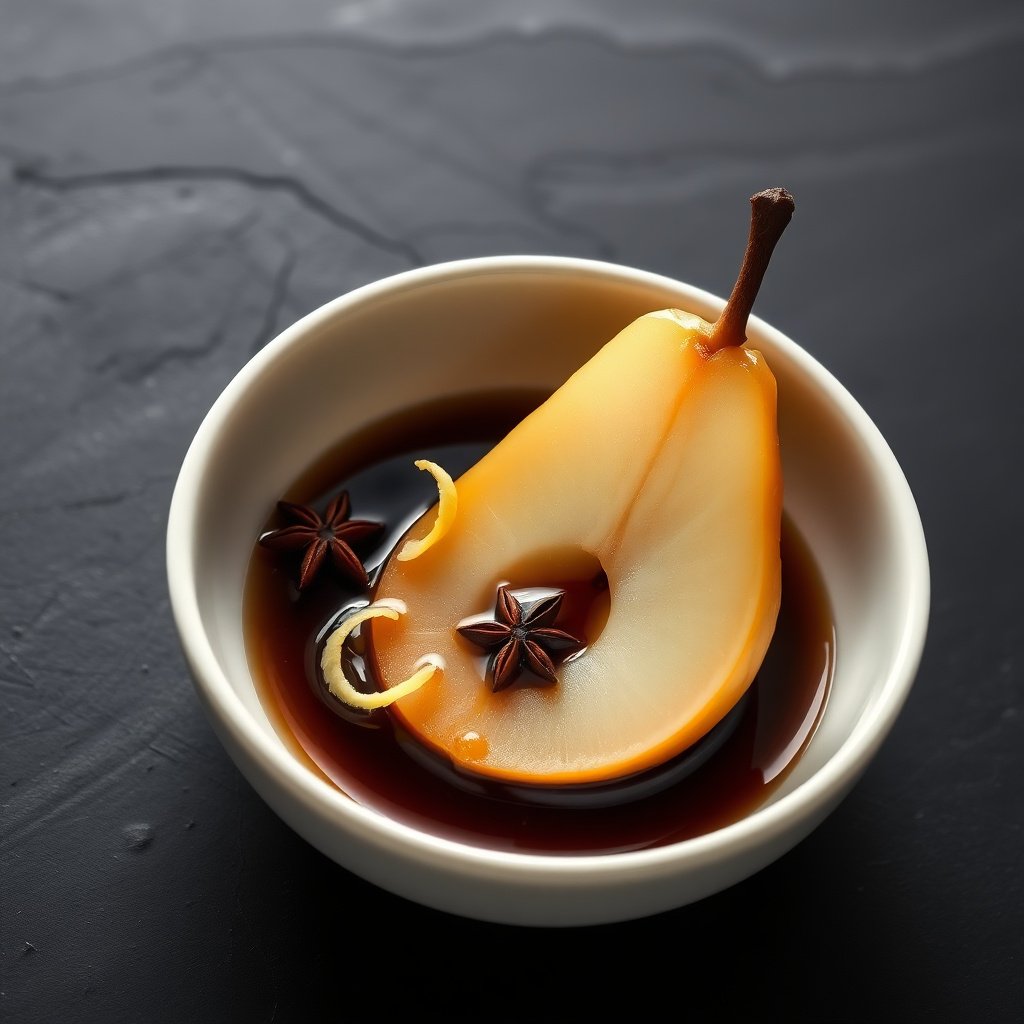
- Serve: To serve, place one or two pear halves in a shallow bowl. Drizzle generously with the warm, reduced syrup. Serve immediately.
Expert Cooking Tips
- Choosing the Right Pears: The success of this dish hinges on your choice of pear. Select varieties that are firm to the touch, such as Bosc or Anjou. These pears have a dense flesh that holds its shape beautifully during the poaching process. Avoid softer varieties like Bartlett, which can turn to mush.
- The Importance of the ‘Cartouche’: Placing a circle of parchment paper directly on the surface of the liquid is a classic French technique. It traps steam and ensures the tops of the pears, which may not be fully submerged, cook at the same rate as the bottoms, preventing discoloration and ensuring a consistent texture.
- Flavor Infusion: For a deeper, more complex flavor, allow the pears to cool completely in their poaching liquid. You can even refrigerate them in the liquid overnight. This gives the fruit more time to absorb the aromatic spices.
- Test, Don’t Guess: The window for perfectly poached pears is precise. Begin testing for doneness around the 20-minute mark. You are aiming for ‘al dente’ – tender through the center but still retaining a slight bite and their structural integrity.
Substitutions and Variations
This recipe is a canvas for your creativity. For the poaching liquid, you can substitute water with dry white wine (like Sauvignon Blanc), dry red wine (like Merlot, which will give the pears a beautiful ruby hue), or even apple cider. Feel free to vary the spices; cardamom pods, fresh ginger slices, or a bay leaf would all be excellent additions. For sweeteners, agave nectar is a great vegan alternative, while coconut sugar can add a caramel note. For a completely sugar-free version, use a natural sweetener like monk fruit or simply omit the sweetener and let the fruit’s natural sugars shine.
Common Mistakes to Avoid
The most frequent error is overcooking the pears until they are soft and falling apart. To avoid this, use firm pears and test for doneness early and often. Another common mistake is boiling the liquid instead of maintaining a gentle simmer. A vigorous boil will break down the pears’ delicate structure. Lastly, don’t skip the step of reducing the poaching liquid. The resulting syrup is what elevates the dish from simple cooked fruit to a true dessert; it concentrates the flavors and provides a beautiful, glossy finish.
Serving Suggestions
Serve the poached pears warm, on their own, for a simple and elegant dessert. For added texture and richness, pair them with a dollop of thick Greek yogurt or a scoop of high-quality vanilla bean ice cream. A sprinkle of toasted nuts, such as sliced almonds or chopped pistachios, provides a delightful crunch. For a more decadent presentation, you can drizzle the pears with a small amount of melted dark chocolate. They also pair wonderfully with savory flavors; try serving a pear half alongside a slice of blue cheese or a sharp cheddar on a cheese board.
Storage and Reheating Tips
Store leftover poached pears and their syrup in an airtight container in the refrigerator for up to 5 days. The flavors will continue to meld and deepen over time, and many people find they are even more delicious on the second day. They can be enjoyed cold, straight from the refrigerator, or gently reheated in a saucepan or microwave.
Nutrition Facts (Estimated)
| Serving Size | 1 poached pear with 2 tbsp syrup |
| Calories | 165 kcal |
| Fat | 0.5g |
| Saturated Fat | 0g |
| Unsaturated Fat | 0.3g |
| Trans Fat | 0g |
| Cholesterol | 0mg |
| Sodium | 5mg |
| Carbohydrates | 40g |
| Fiber | 6g |
| Sugar | 26g |
| Protein | 1g |
Frequently Asked Questions
What are the absolute best pear varieties for poaching?
Bosc pears are widely considered the gold standard for poaching due to their firm, dense flesh and elegant long neck, which holds its shape exceptionally well. Anjou pears (both red and green) are another excellent choice. The key is to choose a pear that is ‘firm-ripe’—it should have a slight give near the stem but still feel very firm overall.
Can I prepare poached pears ahead of time for a dinner party?
Absolutely. In fact, it’s recommended. You can poach the pears a day or two in advance and store them in their poaching liquid in the refrigerator. This allows the flavors to fully infuse the fruit. When you’re ready to serve, you can either serve them chilled or gently reheat them on the stovetop. Reduce the syrup just before serving for the best consistency.
My poaching syrup is watery and didn’t thicken. What went wrong?
The most likely reason is that the liquid was not reduced for long enough. After removing the pears, the liquid must be boiled over medium-high heat to allow excess water to evaporate, which concentrates the sugars and flavors. Be patient with this step; it can take 10-15 minutes or more. Keep in mind that the syrup will appear thinner when hot and will thicken significantly as it cools.
Conclusion
This recipe for elegant poached pears decisively dismantles the notion that dessert must be a dietary transgression. It is a celebration of natural sweetness, aromatic spice, and simple technique. By focusing on whole ingredients and a gentle cooking method, we create a final dish that is both deeply satisfying and perfectly aligned with a health-conscious lifestyle. This is not ‘diet food’; this is simply good food, prepared thoughtfully. It is the definitive dessert that slims you down, not by taking away, but by giving you everything you want: flavor, elegance, and a sense of well-being.